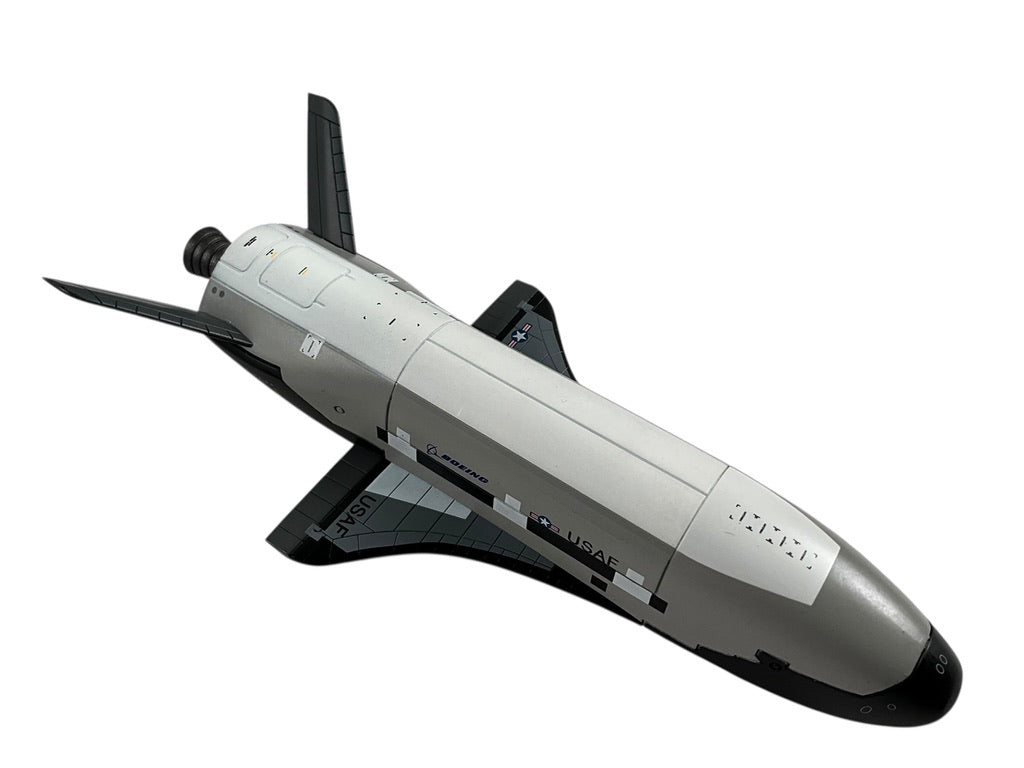
1/72 Dragon Wings (50377-03) Boeing X-37B Orbital Test Vehicle (OTV) Vandenberg AFB 03-12-2010 N.A.S.A./U.S.A.F. (Limited Edition)
On November 17, 2006, the U.S. Air Force announced it would develop the X-37B from the NASA X-37A. The Air Force version is designated X-37B Orbital Test Vehicle (OTV). The OTV program builds on industry and government investments by DARPA, NASA and the Air Force. The X-37B effort will be led by the Air Force Rapid Capabilities Office and includes partnerships with NASA and the Air Force Research Laboratory. Boeing is the prime contractor for the OTV program. The X-37B can remain in orbit for up to 270 days at a time. The first orbital flight of the first X-37B, named USA-212, was launched on an Atlas V rocket at Cape Canaveral Air Force Station, Florida on April 22, 2010, at 23:58 GMT. The spacecraft was placed into low Earth orbit for testing, then will be de-orbited for landing. Following their missions, X-37B spacecraft are to land on a runway at Vandenberg Air Force Base, California with Edwards Air Force Base as an alternate site. A second X-37B is being manufactured for a test mission scheduled for 2011.
Designed as an unmanned reusable spaceplane, the X-37 was first flown in free-flight on April 7th, 2006 and first launched into orbit on April 22nd 20 10. It was originally designed to be carried into orbit by the Space Shuttle but was later redesigned to be launched by a conventional rocket after it was determined that Shuttle launches would be uneconomical. The unmanned design allows for a large payload capacity as well as the ability to remain in orbit for up to 270 days at a time. Possible missions include refuelling or even repairing satellites in orbit using a robotic arm while additional military applications remain classified.