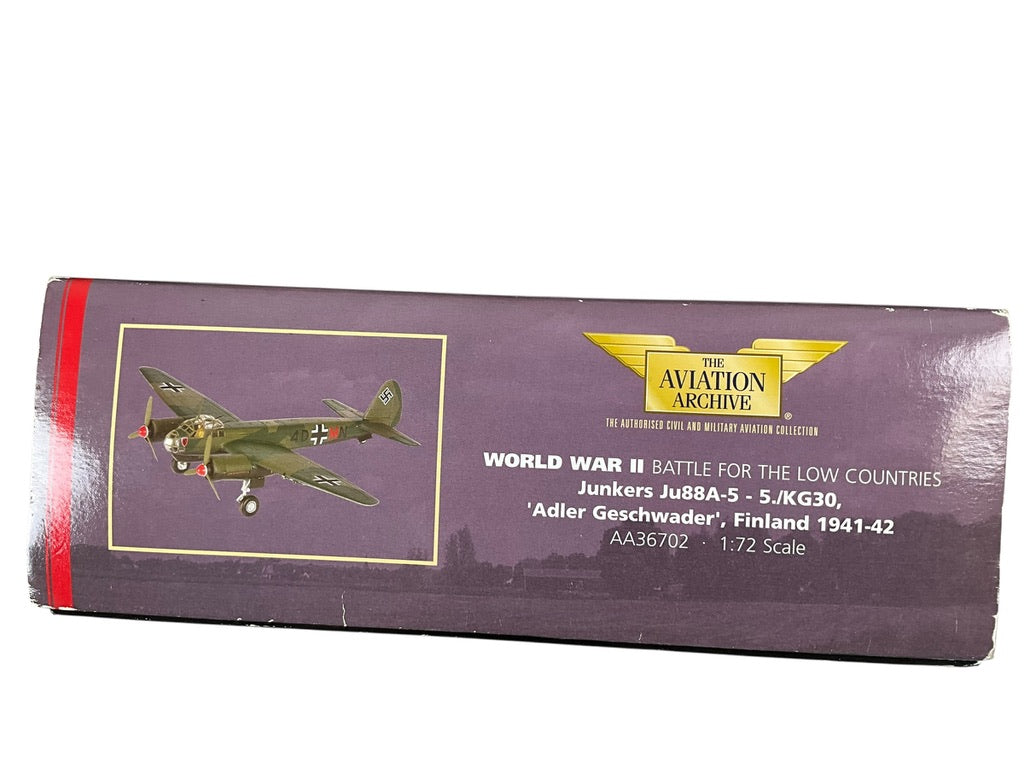
1/72 Corgi (AA36702) Junkers Ju88A-5 (4D+MN) Finland 1941-42 5./KG30 "Adler Geschwader" Dritten Reich Luftwaffe (Limited Edition #0972 of Only 3590)
Corgi Aviation Archive Collector Series AA36702 Junkers Ju 88A-5 Diecast Model Luftwaffe 5./KG 30, "Adler Geschwader", Luftwaffe, Finland, 1941
Limited Edition 3590 Pieces Worldwide
1:72 Scale
Length
Width
Junkers Ju 88A-5
7.75"
11"
This is a model of a medium bomber that participated in the 1941 invasion of the Soviet Union. Officially Finland was neutral in the Russo-German war, but in all practical respects Finland had committed herself to join the Barbarossa. Finnish Defense Forces were fully mobilized and stationed along the eastern border. In northern Finland German ground forces were already operating against the Soviets, and the Luftwaffe was freely using designated Finnish airfields to attack Soviet targets. The Ju 88 was a versatile plane, and Germany's most successful bomber of the war, becoming the Luftwaffe's primary bomber by 1942. It was used through the end of WWII and many versions were produced, with the Ju 88A variant being the original bomber version, and the D variant was an ultra-long range version of the D variant. Ju 88s were provided to Germany's allies Italy, Hungary, Romania, and Finland too. Kampfgeschwafer 30 "Adler" was formed 15th November 1939 in Greifswald. A Stabs-Staffel existed from April 1940-November 1944. On 23rd November 1944 it was redesignated Stab/KG(J)30 and disbanded on 18th April 1945.
Designed to meet a German requirement for a heavy dive bomber, the Ju 88 was first flown on December 21, 1936. Affectionately called "The Maid of all Work," the Ju 88 was one of the most versatile aircraft to serve in WWII. It was used as a bomber, dive bomber, heavy fighter, night fighter, torpedo bomber and reconnaissance aircraft, and was produced in more variants than any other WWII twin-engined German aircraft. The Ju 88 was so successful, in fact, that production continued almost uninterrupted between 1936 and 1945, with more than 16,000 Ju 88s rolling off the line by the end of the war.