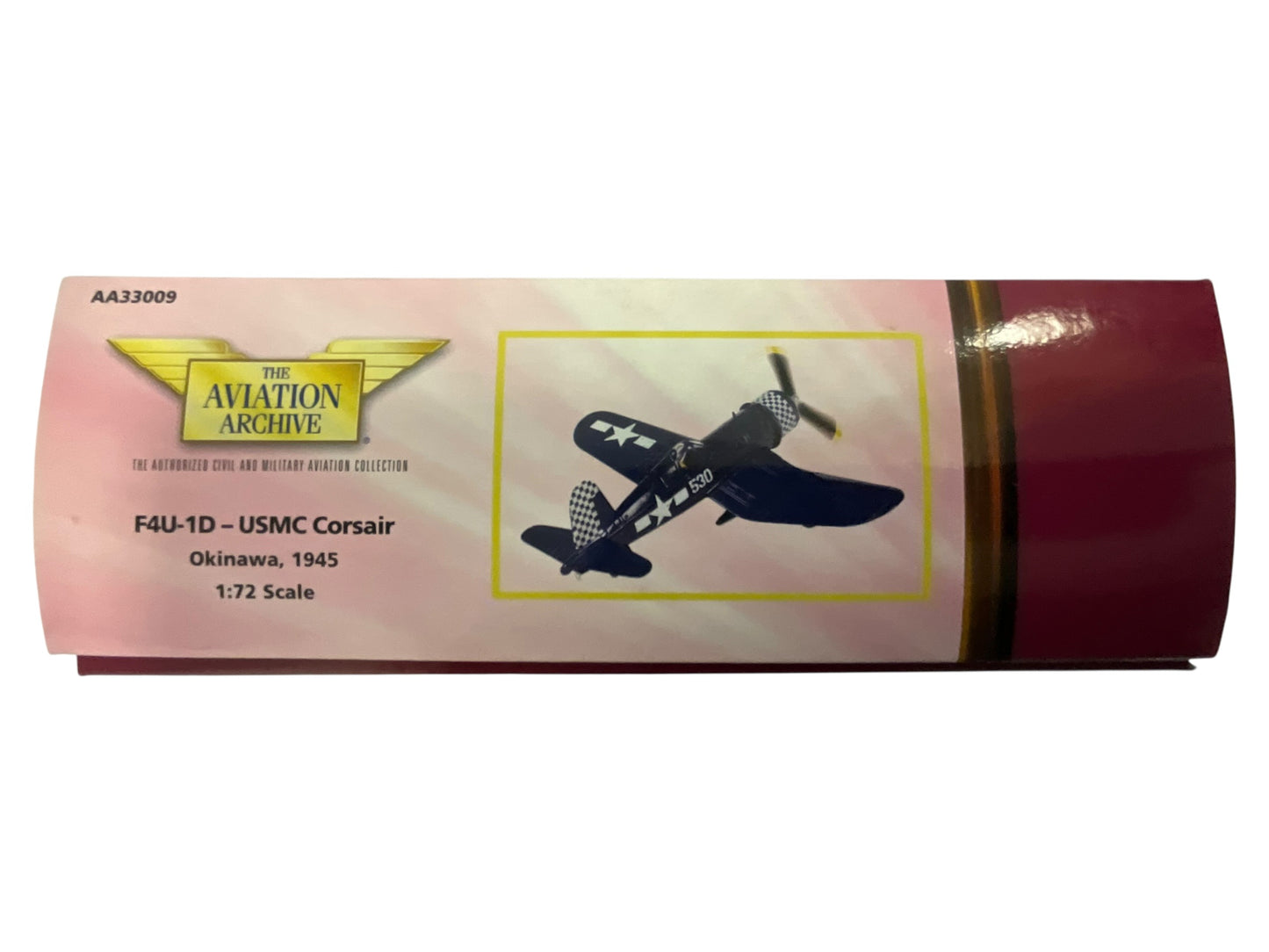
1/72 Corgi (AA33009) Vought F4U-1D Corsair (530) flown by 1st LT. M.O. Chance, Okinawa 1945 VMF-312 U.S.M.C. (limited Edition #1984 of Only 2400)
Corgi Aviation Archive Collector Series AA33009
Vought F4U Corsair Diecast Model
USMC VMF-312 Day's Knights, "White 530", Merritt Chance, Okinawa, Japan, 1945
|
Limited Edi tion
2400
Pieces Worldwide |
|
| 1:72 Scale |
|
Length |
|
Width |
| Vought F4U Corsair |
|
5.5" |
|
6.75" |
Okinawa was the largest amphibious invasion of the Pacific campaign and the last major campaign of the Pacific War. More ships were used, more troops put ashore, more supplies transported, more bombs dropped, more naval guns fired against shore targets than any other operation in the Pacific. More people died during the Battle of Okinawa than all those killed during the atomic bombings of Hiroshima and Nagasaki. Casualties totaled more than 38,000 Americans wounded and 12,000 killed or missing, more than 107,000 Japanese and Okinawan conscripts killed, and perhaps 100,000 Okinawan civilians who perished in the battle. The battle of Okinawa proved to be the bloodiest battle of the Pacific War. Thirty-four allied ships and craft of all types had been sunk, mostly by kamikazes, and 368 ships and craft damaged. The fleet had lost 763 aircraft. Total American casualties in the operation numbered over 12,000 killed [including nearly 5,000 Navy dead and almost 8,000 Marine and Army dead] and 36,000 wounded.
Designed to meet a US Navy requirement for a single-seat carrier based fighter, the F4U was first flown on May 29th, 1940. This versatile aircraft saw service with both the Navy and Marine Corps in WW II and in the Korean War. During its lifetime, the Corsair underwent numerous improvements such as a lengthened fuselage, a high visibility bubble-top canopy and folding inverted gull wings that provided clearance for a large propeller. Its performance advantage, 400 mph capability, the ability to withstand punishment and six .50 Browning machine guns made the F4U a devastating weapon against aircraft, ground targets and ships.
© Copyright 2003-2026 The Flying Mule, Inc.