

airdrop militaria
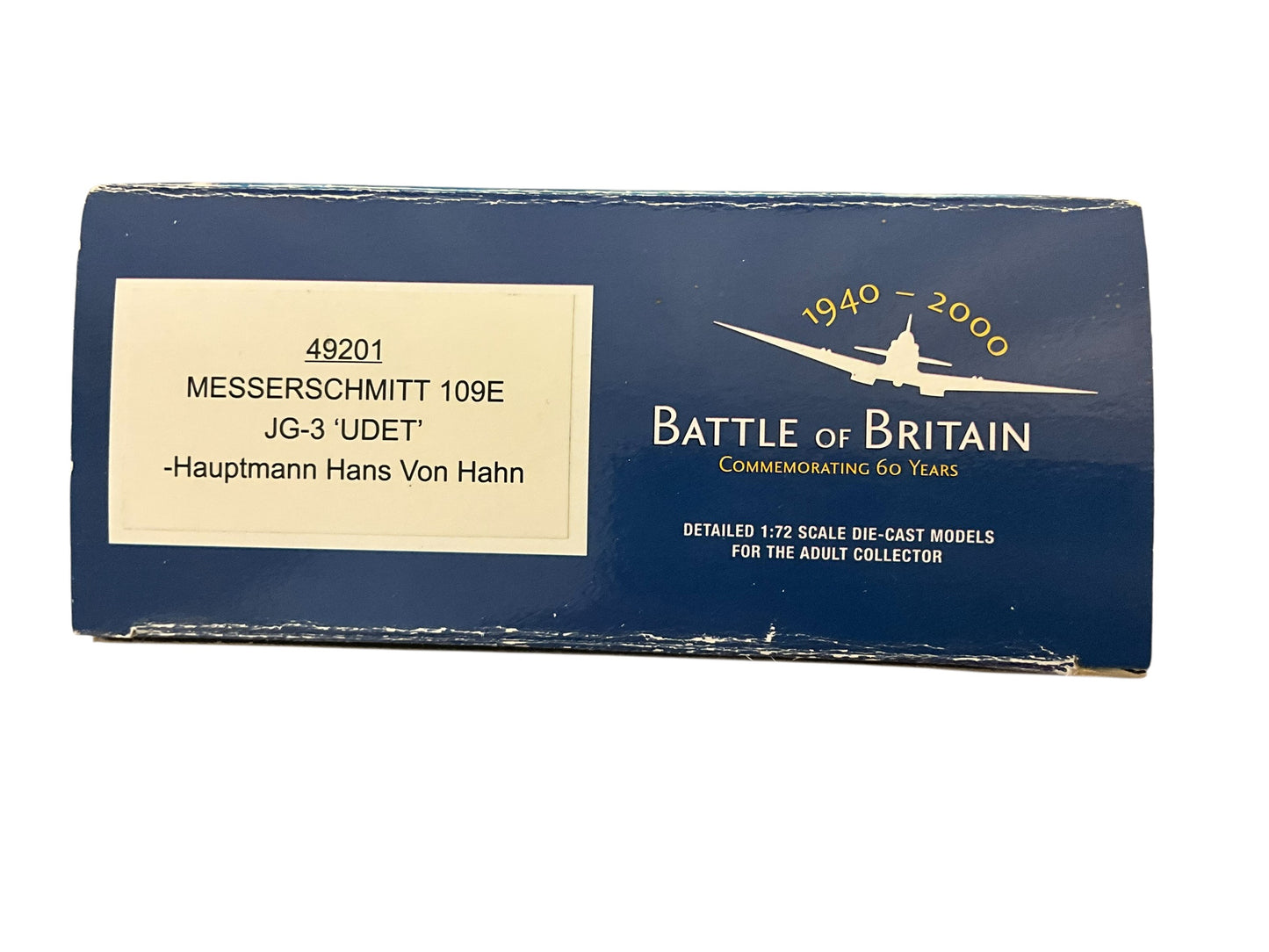
1/72 Corgi (49201) Messerschmitt Bf109E flown by Hauptmann Hans "Vati" von Hahn JG3 "Udet" Drittes Reich Luftwaffe (Limited Edition) 2000 Release
1/72 Corgi (49201) Messerschmitt Bf109E flown by Hauptmann Hans "Vati" von Hahn JG3 "Udet" Drittes Reich Luftwaffe (Limited Edition) 2000 Release
Couldn't load pickup availability
1/72 Corgi (49201) Messerschmitt Bf109E flown by Hauptmann Hans "Vati" von Hahn JG3 "Udet" Drittes Reich Luftwaffe (Limited Edition) 2000 Release
1/72 Corgi (49201)
|
| 1:72 Scale | Length | Width | ||
|---|---|---|---|---|
| Messerschmitt Bf 109E | 5" | 5.5" |
The Messerschmitt Bf 109E was the mainstay of the Luftwaffe's fighter squadrons during the Battle of Britain. Generally regarded as being at least as effective as the Spitfire, the leading German Messerschmitt pilots were among the best aerial fighters the world had ever seen. Among the many fighter units which utilised the Bf 109E were JG 2 "Richthofen", JG 26 "Schlageter" (later commanded by Adolf Galland) and the unit which this model came from, JG 3 "Udet". It was flown by Group Commander Hauptmann Hans "V ati" von Hahn, who ended the war with 34 kills.
Messerschmitt Bf 109E
Designed to meet a Luftwaffe need for a single-seat fighter/interceptor, the Messerschmitt Bf 109 was first flown on May 28th, 1935. Its all-metal construction, closed canopy and retractable gear made the Bf 109 one of the first true modern fighters of WWII. This versatile aircraft served in many roles and was the most produced aircraft of the war and the backbone of the Luftwaffe, and was flown by Germany's top three aces, who claimed a total of 928 victories between them. Armed with two cannons and two machine guns, the Bf 109's design underwent constant revisions, which allowed it to remain competitive until the end of the war.
© Copyright 2003-2026 The Flying Mule, Inc.
Hans von Hahn
|
|
|
|---|---|
| Born | 7 August 1914 |
| Died | 5 November 1957 (aged 43) |
| Allegiance |
 Nazi Germany Nazi Germany
|
|
Branch
|
 Kriegsmarine (1934–1935) Luftwaffe (1935–1945) Kriegsmarine (1934–1935) Luftwaffe (1935–1945) |
|
Service years
|
1934–45 |
|
Rank
|
Hauptmann (captain) |
| Unit |
JG 53, JG 3, JG 1, JG 103 Jagdfliegerführer Oberitalien |
| Commands | I./JG 3, II./JG 1, JG 103 Jagdfliegerführer Oberitalien |
|
Conflicts
|
|
| Awards | Knight's Cross of the Iron Cross |
Hans von Hahn (7 August 1914 – 5 November 1957) was a Luftwaffe ace and recipient of the Knight's Cross of the Iron Cross during World War II. The Knight's Cross of the Iron Cross, and its variants were the highest awards in the military and paramilitary forces of Nazi Germany during World War II. During his career he was credited with 34 aerial victories, 15 on the Western Front and 19 on the Eastern Front.
World War II
World War II in Europe began on Friday 1 September 1939 when German forces invaded Poland. On 18 September 1939, Hahn was appointed Staffelkapitän of 8. Staffel (8th squadron) of Jagdgeschwader 53 (JG 53—53rd Fighter Wing). He was the first commander of the Staffel which was part of the newly created III. Gruppe (3rd group) of JG 53 under the command of Hauptmann Werner Mölders.[1] Hahn claimed his first aerial victory on 22 December 1939 during "Phoney War". That day, he claimed a Royal Air Force (RAF) Hawker Hurricane fighter from the No. 73 Squadron.[2]
On 27 August 1940, Hahn was appointed Gruppenkommandeur (group commander) of I. Gruppe of Jagdgeschwader 3 (JG 3—3rd Fighter Wing). He replaced Oberleutnant Lothar Keller who had temporarily led the Gruppe after its former commander Hauptmann Günther Lützow had been Geschwaderkommodore (wing commander) of JG 3 on 21 August.[3] Command of 8. Staffel of JG 53 was given to Oberleutnant Hans Kunert.[4]
War against the Soviet Union
In preparation for Operation Barbarossa, the German invasion of the Soviet Union, the I. Gruppe moved to an airfield at Dub on 18 June 1941. At the start of the campaign, JG 3 was subordinated to the V. Fliegerkorps (5th Air Corps), under command of General der Flieger Robert Ritter von Greim, which was part of Luftflotte 4 (4th Air Fleet), under command of Generaloberst Alexander Löhr. These air elements supported Generalfeldmarschall Gerd von Rundstedt's Heeresgruppe Süd (Army Group South), with the objective of capturing Ukraine and its capital Kiev.[5]
Hahn was awarded the Knight's Cross of the Iron Cross (Ritterkreuz des Eisernen Kreuzes) on 9 July for 21 aerial victories.[6]
On 15 January 1942, I. Gruppe was detached from JG 3 and became the newly formed II. Gruppe of Jagdgeschwader 1 (JG 1—1st Fighter Wing). In consequence, Hahn commanded this Gruppe until June 1942 when he was temporarily replaced by Oberleutnant Detlev Rohwer.[7]
Summary of career
Aerial victory claims
According to Obermaier, Hahn was credited with 34 aerial victories claimed in over 300 combat missions. This figure includes 19 claims on the Eastern Front and 15 over the Western Allies.[8] Mathews and Foreman, authors of Luftwaffe Aces — Biographies and Victory Claims, researched the German Federal Archives and found records for 31 aerial victory claims, plus three further unconfirmed claims. This figure of confirmed claims includes 19 aerial victories on the Eastern Front and 12 on the Western Front.[9]
| Chronicle of aerial victories | |||||||||
|---|---|---|---|---|---|---|---|---|---|
|
This and the – (dash) indicates unconfirmed aerial victory claims for which Hahn did not receive credit.
|
|||||||||
| Claim | Date | Time | Type | Location | Claim | Date | Time | Type | Location |
| – 8. Staffel of Jagdgeschwader 53 –[9] "Phoney War" — 26 September 1939 – 9 May 1940 |
|||||||||
| 1 | 22 December 1939 | 15:05 | Hurricane | 15 km (9.3 mi) northeast of Metz[10] | |||||
| – 8. Staffel of Jagdgeschwader 53 –[9] Battle of France — 10 May – 25 June 1940 |
|||||||||
| 2 | 21 May 1940 | 19:10 | LeO 451 | Châlons[11] | 4 | 31 May 1940 | 19:08 | Curtiss | Abbeville[11] |
|
—
|
21 May 1940 |
—
|
M.S.406 | east of Paris[11] | 5 | 3 June 1940 | 14:35 | Hurricane | Paris[11] |
|
—
|
21 May 1940 |
—
|
Curtiss | east of Paris[11] |
—
|
3 June 1940 |
—
|
M.S.406 | Paris[12] |
| 3 | 24 May 1940 | 18:15 | Curtiss[11] | 6 | 7 June 1940 | 16:53 | M.S.406 | Compiègne[12] | |
| – 8. Staffel of Jagdgeschwader 53 –[9] Battle of Britain and on the English Channel — 26 June – 26 August 1940 |
|||||||||
| 7 | 25 August 1940 | 18:27 | Spitfire | 10 km (6.2 mi) east of Portland[13] | |||||
| – Stab I. Gruppe of Jagdgeschwader 3 –[9] Battle of Britain and on the English Channel — 27 August 1940 – 9 June 1941 |
|||||||||
| 8 | 5 September 1940 |
—
|
Spitfire | vicinity of London[14] | 11 | 7 October 1940 |
—
|
Hurricane | Thames Estuary[14] |
| 9 | 15 September 1940 |
—
|
Spitfire | north of London[14] | 12 | 10 January 1941 | 14:35 | Blenheim | 25 km (16 mi) northeast of Nieuwpoort[14] |
| 10 | 7 October 1940 |
—
|
Hurricane | Thames Estuary[14] | |||||
| – Stab I. Gruppe of Jagdgeschwader 3 –[9] Operation Barbarossa — 22 June – 16 September 1941 |
|||||||||
| 13 | 25 June 1941 | 15:10 | I-153 | 20 km (12 mi) northeast of Dubno[15] | 23 | 10 July 1941 | 15:15 | SB-2 | 4 km (2.5 mi) south of Barbolok[16] |
| 14 | 26 June 1941 | 06:10 | DB-3 | northeast of Brody[15] | 24 | 12 July 1941 | 14:55 | DB-3 | 15 km (9.3 mi) east of Zhytomyr[17] |
| 15 | 26 June 1941 | 06:15 | DB-3 | northeast of Brody[15] | 25 | 14 July 1941 | 14:30 | DB-3 | 30 km (19 mi) southwest of Berdychiv[17] |
| 16 | 26 June 1941 | 14:20 | SB-2 | Szczurowcze[15] | 26 | 14 July 1941 | 14:31 | DB-3 | 30 km (19 mi) southwest of Berdychiv[17] |
| 17 | 29 June 1941 | 15:00 | I-153 | 12 km (7.5 mi) west of Brody[18] | 27 | 14 July 1941 | 14:32 | DB-3 | 30 km (19 mi) southwest of Berdychiv[17] |
| 18 | 29 June 1941 | 15:05 | I-153 | 12 km (7.5 mi) west of Brody[18] | 28 | 11 August 1941 | 06:45 | SB-2 | 6 km (3.7 mi) southeast of Wihenkij[17] |
| 19 | 5 July 1941 | 11:45 | Pe-2 | northwest of Gudnow[19] | 29 | 11 August 1941 | 06:48 | SB-2 | 6 km (3.7 mi) west of Boryspil[17] |
| 20 | 6 July 1941 | 15:40 | DB-3 | southeast of Shepetivka[19] | 30 | 14 August 1941 | 12:50 | I-16 | 10 km (6.2 mi) southeast of Kaniv[20] |
| 21 | 6 July 1941 | 15:45 | DB-3 | southeast of Shepetivka[19] | 31 | 16 August 1941 | 10:00 | I-17 (MiG-1) | 3 km (1.9 mi) southwest of Kaniv[20] |
| 22 | 10 July 1941 | 15:10 | I-17 (MiG-1) | 10 km (6.2 mi) south of Kurin[16] | |||||
Awards
- Iron Cross (1939) 2nd and 1st Class[21]
- Knight's Cross of the Iron Cross on 9 July 1941 as Hauptmann and Gruppenkommandeur of the I./Jagdgeschwader